OFFICIAL WSDOT E-BIKE PROGRAM

Washington e-bike rebates are open

Eligible Washington residents may qualify for a $300 rebate or a $1,200 income-qualified rebate.

$300Standard$1,200Income-qualified
Check Eligibility & Program Details

PARENT READINESS CHECK

Pilot Complete: 30 Parent Responses Received

Thank you to the parents and caregivers who helped test the Know Your Ride Parent Readiness Check. Findings from this pilot are now being used to refine the assessment before its broader public launch.

Community Guide

Worried about e-bikes nearby? Start with facts, not assumptions.

E-bikes can raise real safety concerns, especially around sidewalks, school entrances, parks, trails, and crowded neighborhood spaces. But a bike's appearance alone does not always tell the full story. This guide helps neighbors and community groups respond calmly, check the right details, and focus on safer riding without shaming young riders.
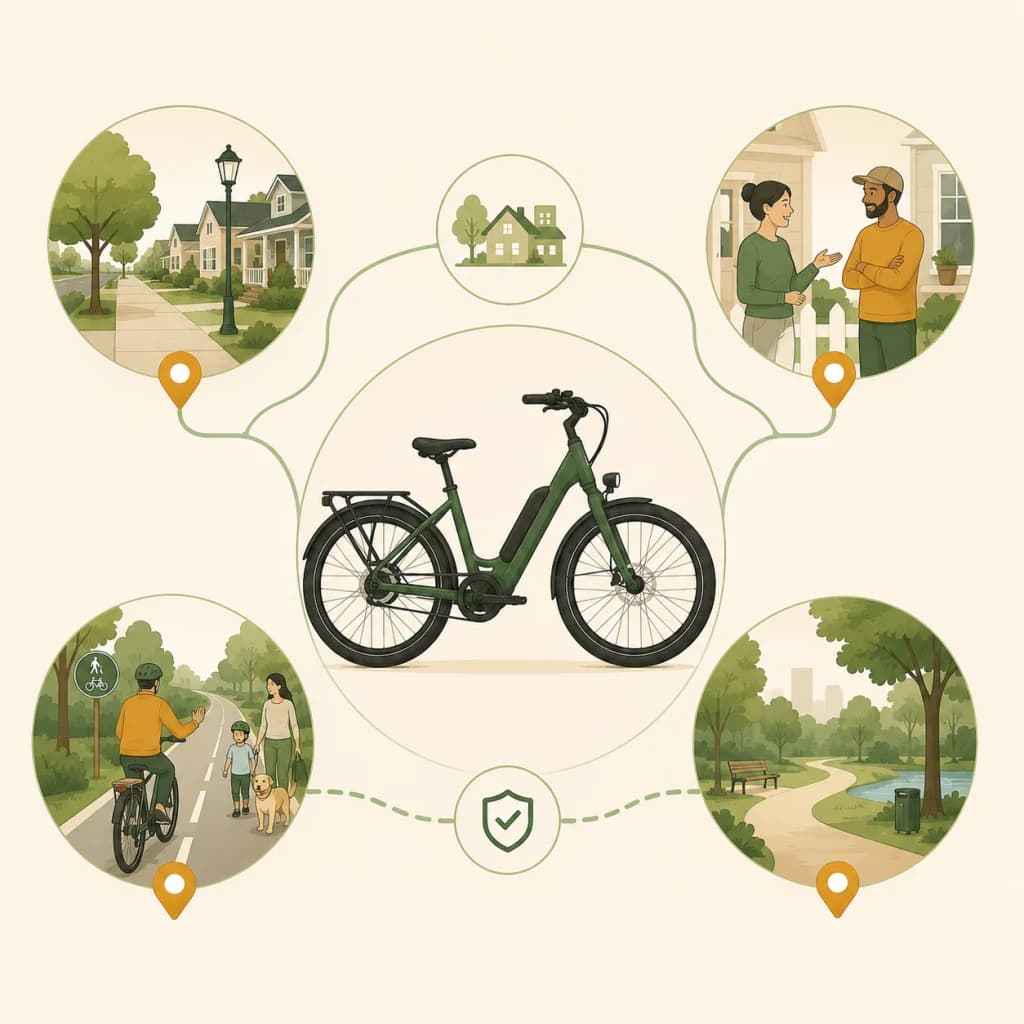
Illustration of neighborhood riding, shared paths, pedestrians, homes, and calm community conversation around e-bike safety.

Community moment

A safer conversation starts before the comment thread.

When someone sees an e-bike moving too fast, riding near pedestrians, or cutting through a crowded space, the reaction can be immediate. But online arguments rarely solve the problem. A better first step is to separate three things: what the bike is, where it is being used, and how it is being ridden.

FACT CHECK

Check the bike, not just the shape

Some legal e-bikes can look powerful. Some powerful-looking bikes need closer review. Appearance alone is not enough.

BEHAVIOR FIRST

Separate the rule from the behavior

A bike may be allowed in one place, but reckless riding, crowding pedestrians, or ignoring traffic rules can still be a problem.

LOCATION MATTERS

Look at the location

Sidewalks, shared paths, parks, trails, school entrances, and private community spaces may have different rules.

CALM WORDS

Avoid naming or shaming kids

Focus on the behavior, place, and safety concern. Public blame can make families defensive instead of helpful.

CALM WORDS

Share a tool, not a fight

When a thread gets heated, link to a calm resource that helps families check the bike, route, and expectations.

What to say

Helpful language beats angry language.

You can care about safety without accusing every rider or every parent. These phrases keep the focus on facts, behavior, and shared spaces.

Say this

  • "I'm concerned about speed near pedestrians and school entrances."
  • "Can we help families check which bikes are allowed where?"
  • "Some e-bikes look similar, so I'd rather start with the label and settings."
  • "The behavior is the issue here: speed, passengers, helmets, and riding too close to people."
  • "Let's share a reliable guide instead of guessing from the photo."

Avoid this

  • "All these bikes are illegal."
  • "Kids should not have e-bikes at all."
  • "Parents do not care."
  • "That bike looks like a motorcycle, so it must be illegal."
  • "Someone should publicly identify the rider."

Before you post

Pause before turning one moment into a public judgment.

Community posts can help people learn, but they can also spread confusion quickly. Before posting about a rider, bike, or family, check whether the concern is about the bike's classification, the rider's behavior, the location, or an immediate safety risk.

FACT CHECK

Is this about the bike?

Can anyone confirm the class label, wattage, throttle behavior, speed limit, or unlockable settings?

LOCATION MATTERS

Is this about the place?

Was the rider on a sidewalk, street, shared path, trail, school campus, park, or private community property?

BEHAVIOR FIRST

Is this about the behavior?

Was the concern speed, passengers, wheelies, weaving, no helmet, ignoring signs, or riding too close to people?

HELP FIRST

Is there immediate danger?

If someone is hurt or there is an urgent safety issue, get help first. Online discussion can wait.

Good rule of thumb

If the goal is safety, describe the behavior and location. Do not identify or shame a child.

Looks can mislead

A bike can look powerful and still need a fact check.

Some e-bikes look like small motorcycles. Some are still sold or labeled as e-bikes. Others may have settings or features that need closer review. The safest response is not to guess from appearance alone, but to check the bike details and the place where it is being used.

FACT CHECK

Look for the label

The class label, model details, motor rating, and speed information matter more than the product photo.

FACT CHECK

Ask about throttle behavior

A throttle that moves the bike on its own, especially above common e-bike limits, deserves closer review.

FACT CHECK

Check for unlock modes

App settings, off-road modes, race modes, or limiter changes can affect how the bike should be evaluated.

BEHAVIOR FIRST

Watch the real-world use

A bike used calmly in the right place is different from a bike ridden fast through pedestrians, crossings, or school traffic.

Where to go

Choose the right next step for the concern.

Not every concern belongs in the same place. The right next step depends on whether the issue is school behavior, park or trail use, private property, road safety, or immediate danger.

LOCATION MATTERS

School arrival or bike rack issue

Start with the school's published expectations or school administration. Focus on arrival, parking, helmets, passengers, and campus behavior.

LOCATION MATTERS

HOA or private community space

Check community rules for paths, parks, open spaces, and common areas. Share expectations clearly with residents.

LOCATION MATTERS

City street or sidewalk concern

Check city and state guidance. For repeated unsafe behavior, use the appropriate city or law enforcement non-emergency process.

LOCATION MATTERS

Park, trail, or shared-use path

Check the agency or trail manager responsible for that location. Trail rules can vary by surface, use, and local policy.

HELP FIRST

Immediate danger or injury

If there is a crash, injury, or urgent risk, call emergency services when needed and get help first.

Share instead of arguing

When the thread gets heated, share something useful.

Community concern is valid. So is the need for accuracy. If a conversation turns into blame or confusion, share a calm resource that helps families check the bike, the rider, the route, and the rules.

Copy-and-paste community reply

I understand the concern about e-bikes and safety. It can be hard to tell what a bike is just by looking at it, and behavior matters too. This guide helps families and neighbors check the bike details, route, rider expectations, and official sources without shaming kids or guessing from appearance.

Best link to share

Use this guide when a neighborhood, HOA, school, or parent group discussion needs calm facts and practical next steps.

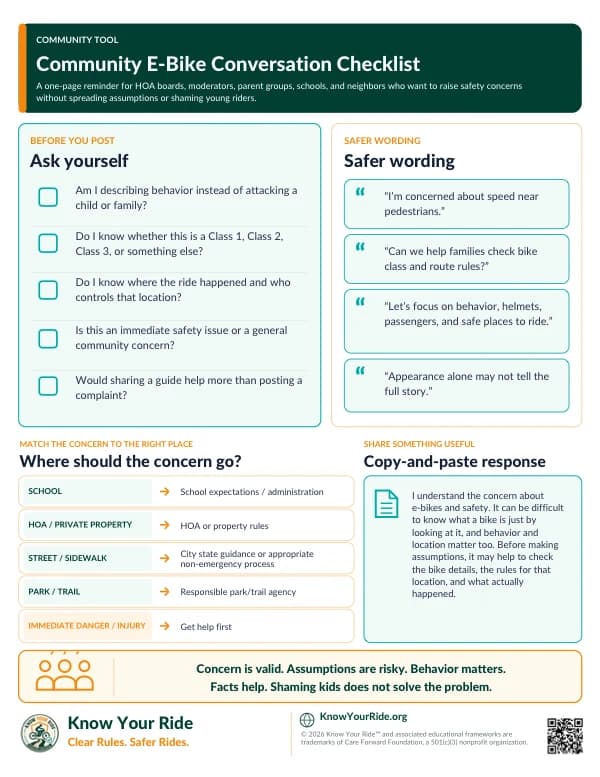
Community E-Bike Conversation Checklist

A one-page reminder for HOA boards, moderators, parent groups, and neighbors who want to raise safety concerns without spreading assumptions or shaming kids.

CALM WORDS

Checklist

  • Am I describing behavior instead of attacking a child or family?
  • Do I know whether this is a Class 1, Class 2, Class 3, or something else?
  • Do I know where the ride happened and who controls that location?
  • Is this an immediate safety issue or a general community concern?
  • Would sharing a guide help more than posting a complaint?

Safer wording

  • "I'm concerned about speed near pedestrians."
  • "Can we help families check bike class and route rules?"
  • "Let's focus on behavior, helmets, passengers, and safe places to ride."
  • "Appearance alone may not tell the full story."

Concern is valid. Assumptions are risky. Behavior matters. Facts help. Shaming kids does not solve the problem.