Start here
State baseline
Washington definitions help explain what counts as an electric-assisted bicycle.
OFFICIAL WSDOT E-BIKE PROGRAM
Eligible Washington residents may qualify for a $300 rebate or a $1,200 income-qualified rebate.
Rules & Places
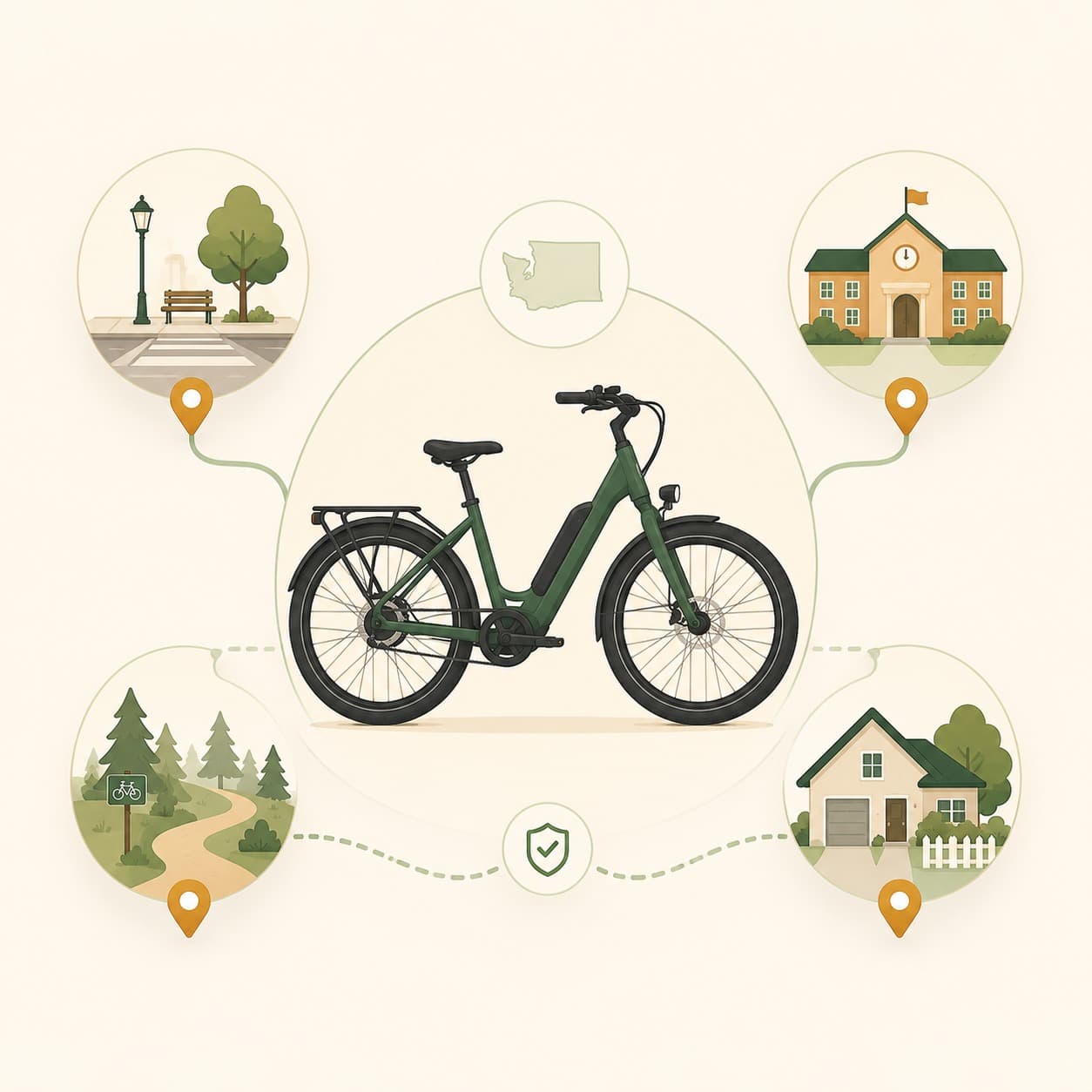
Washington has statewide e-bike definitions, but where a bike can be used may depend on the city, school, park, trail, or private-property rules for that place. Start with the bike, then check the location.
Source-aware hub
E-bike questions can touch state definitions, city streets, school property, parks, trails, and private spaces. Know Your Ride keeps summaries careful and points families back to official sources before they rely on a rule.
Washington baseline
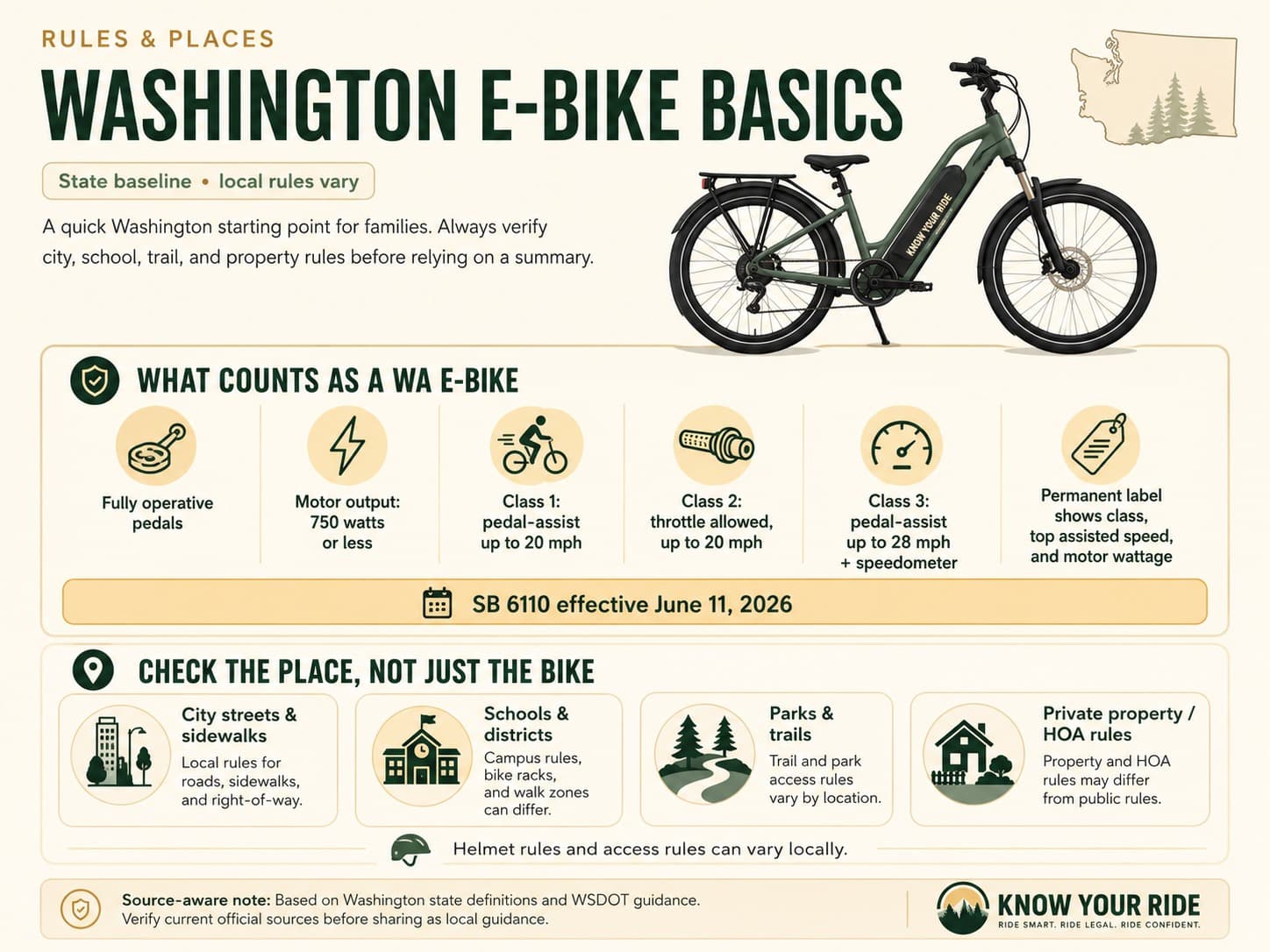
Use this as a quick starting point. Then check the exact place where the ride will happen.
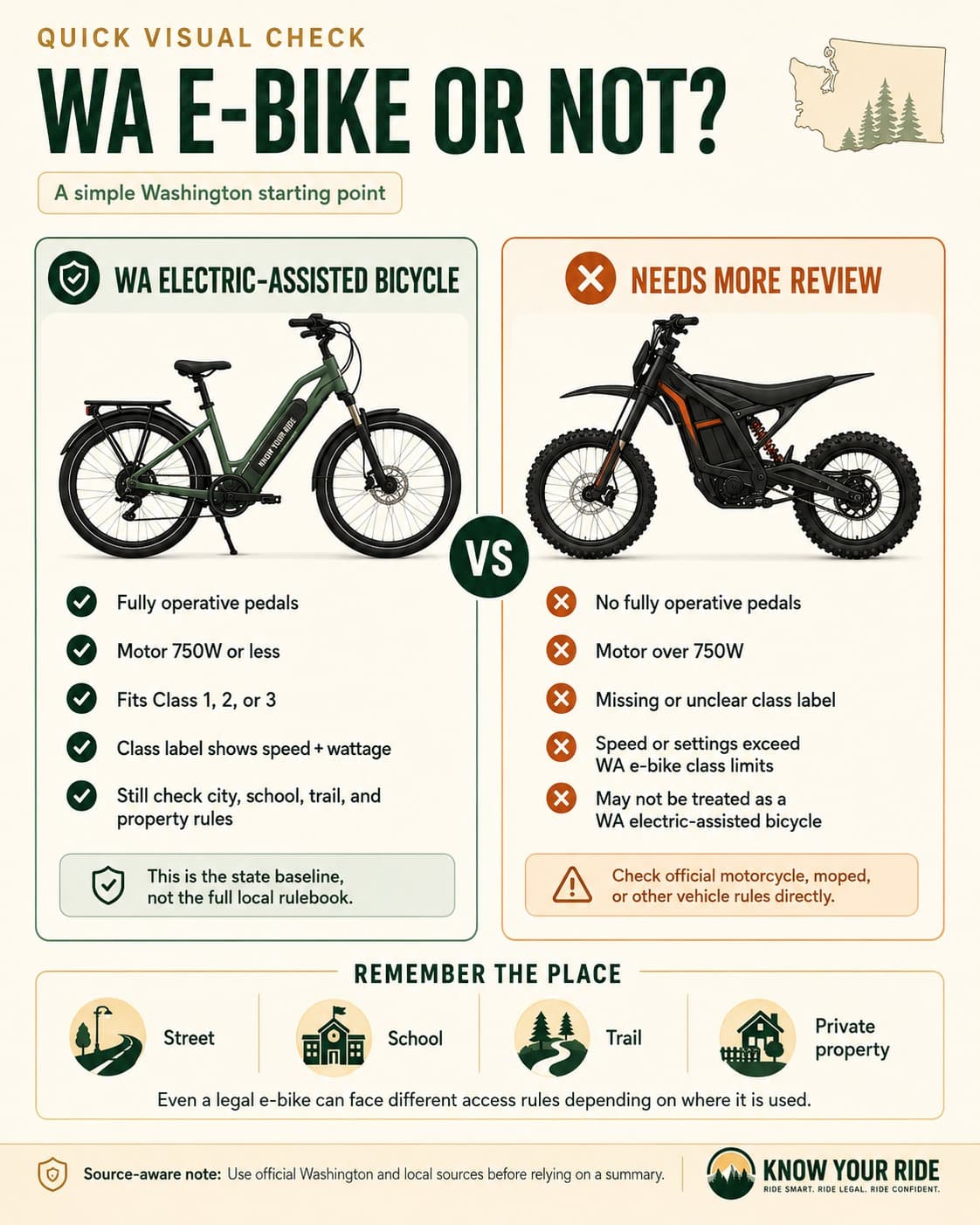
This visual is a plain-language starting point based on Washington state definitions and WSDOT guidance. Verify official sources before sharing as local guidance.
Quick visual check
Some legal e-bikes can look powerful. Some powerful-looking vehicles may need closer review. Appearance alone is not enough.
Use the visual as a screening tool, not a final legal decision. If pedals, motor rating, label, speed, throttle behavior, or settings are unclear, verify with official sources before relying on a conclusion.
Rule contexts
Use these cards as a quick reminder before repeating a rule as public guidance.
Washington definitions help explain what counts as an electric-assisted bicycle.
City rules, sidewalk expectations, right-of-way guidance, and local transportation pages can vary by place.
Campus rules, bike rack locations, walk zones, and student conduct expectations should come from district or school sources.
Trail managers, parks agencies, HOAs, and private property owners may set access rules that differ from street rules.
WASHINGTON SOURCE MAP
Use these cards to compare how schools, cities, transportation sources, public-health agencies, and community safety resources explain bike, e-bike, helmet, route, and campus expectations. Know Your Ride helps people find source material, but it does not replace official guidance for a specific school, city, trail, park, or property.
Know Your Ride links to official and source-review-needed school, district, city, county, public-health, and community sources for educational reference. External links do not imply endorsement or partnership. Families should verify current rules directly with their school, district, city, trail, park, or official agency before relying on any summary.
Filter by source type
Filter by region
Hear directly from local police, city, and public-safety agencies about e-bike safety, rider behavior, and community expectations. These resources add helpful local context; always verify current rules with the official source responsible for where you ride.
* Some browsers may ask permission before loading embedded videos. Loading a video may share data with the hosting platform.
Issaquah Police E-Bike Safety Video
Press play to start from Facebook
This video is hosted by Facebook. Loading it may share data with Facebook/Meta.
Sammamish Police E-Bike Safety Video
Press play to start from YouTube
This video is hosted by YouTube. Loading it may share data with YouTube/Google.
Redmond Police E-Bike Safety Video
Press play to start from YouTube
This video is hosted by YouTube. Loading it may share data with YouTube/Google.
Start with state-level definitions, statutes, and transportation guidance before summarizing rules for families or schools.
Washington State
Washington State Legislature
Official Washington Legislature source for the 2026 e-bike and electric motorcycle updates. Use this before publishing summaries about SB 6110, effective dates, definitions, or implementation details.
Listing this source does not imply the Washington State Legislature endorses Know Your Ride. Last checked: 2026-06-12.
Washington State
Washington State Department of Transportation
WSDOT summarizes bicycle definitions, e-bike classifications, bicyclist responsibilities, helmet requirements, and safety tips for Washington riders.
Listing this source does not imply WSDOT endorses Know Your Ride. Last checked: 2026-06-12.
Washington State
Washington State Legislature
The RCW defines electric-assisted bicycles and the three Washington e-bike classes by pedals, motor output, assisted speed, throttle behavior, and speedometer requirements.
Listing this source does not imply the Washington State Legislature endorses Know Your Ride. Last checked: 2026-06-12.
Local pages can clarify how city streets, parks, corridors, and public-safety teams communicate e-bike expectations.
Redmond, WA
City of Redmond
Official Redmond e-bike safety guidance covering e-bike classes, assisted speeds, Class 3 age and location restrictions, safe riding expectations, and local context.
Listing this source does not imply the City of Redmond endorses Know Your Ride. Last checked: 2026-06-12.
Kirkland, WA
City of Kirkland
Official Kirkland guidance explaining e-bike classes, e-bike versus e-motorcycle context, Cross Kirkland Corridor expectations, park/path considerations, and links to applicable rules.
Listing this source does not imply the City of Kirkland endorses Know Your Ride. Last checked: 2026-06-12.
Sammamish, WA
City of Sammamish / Sammamish Police
Official Sammamish guidance explaining e-bike and e-motorcycle differences, e-bike class rules, shared-use path access, sidewalk restrictions, roadway bicycle facilities, and local safety expectations.
Listing this source does not imply the City of Sammamish or Sammamish Police endorses Know Your Ride. Last checked: 2026-06-13.
School and district sources can help families compare arrival routines, bike rack expectations, walk-zone language, and campus communication.
Bellevue / Eastside
Bellevue School District
School-district guidance on e-bikes and personal transportation devices, including campus riding expectations, helmet expectations, sidewalk and campus restrictions, storage, batteries, e-scooters, and e-motorcycle distinctions.
Listing this source does not imply Bellevue School District endorses Know Your Ride. Last checked: 2026-05-30.
Issaquah / Eastside
Issaquah School District
District announcement with e-bike class definitions, rider safety reminders, helmet reminders, and electric dirt-bike distinction.
Listing this source does not imply Issaquah School District endorses Know Your Ride. Last checked: 2026-05-30.
Mercer Island / Eastside
Mercer Island School District
School-district e-bike safety page explaining riding expectations, e-bike/electric motorcycle differences, and coordination with city safety education.
Listing this source does not imply Mercer Island School District endorses Know Your Ride. Last checked: 2026-05-30.
Source check
Know Your Ride separates useful starting points from claims that still need official verification.
Beyond Washington
E-bike rules vary by state and can change. Know Your Ride focuses on Washington guidance, but families comparing other states should check state law, transportation agencies, and current local rules.
The federal low-speed electric bicycle definition includes two or three wheels, fully operable pedals, an electric motor under 750 watts, and a motor-powered speed under 20 mph on a paved level surface under the stated test conditions. This is a consumer product safety definition, not a complete road, trail, school, or local access rulebook.
PeopleForBikes maintains a state-by-state e-bike law page and notes that e-bike laws differ by state. Treat it as a helpful overview, then verify with official state and local sources.
Even if a bike fits a state class, cities, parks, trails, schools, and private property may still have separate rules.
Know Your Ride focuses on Washington. National and state-by-state pages are starting points only. Always verify current official state and local sources before relying on a rule.