OFFICIAL WSDOT E-BIKE PROGRAM

Washington e-bike rebates are open

Eligible Washington residents may qualify for a $300 rebate or a $1,200 income-qualified rebate.

$300Standard$1,200Income-qualified
Check Eligibility & Program Details

PARENT READINESS CHECK

Pilot Complete: 30 Parent Responses Received

Thank you to the parents and caregivers who helped test the Know Your Ride Parent Readiness Check. Findings from this pilot are now being used to refine the assessment before its broader public launch.

Parent Guide

Before you say yes, understand what you are approving.

A bike can look simple on a product page, exciting at a shop, or already familiar in the garage. But before approving a ride, families should check the details that shape safety: the label, pedals, throttle, speed, wattage, unlockable settings, route, rider age, helmet habits, and school expectations.

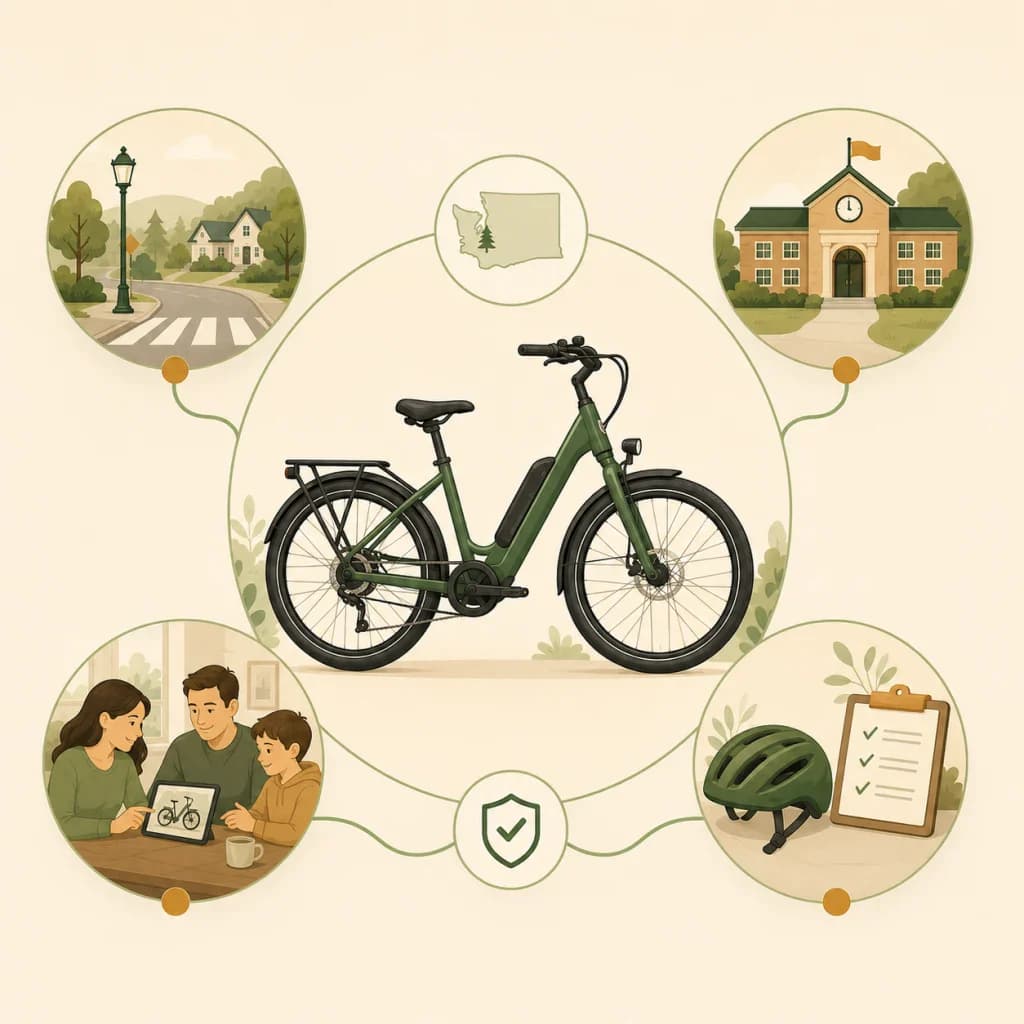
Illustration of a family reviewing e-bike details, safety checklist, route, and school context before approving a ride.

Parent moment

Safest ride often starts before the yes

Before a student rides to school, a friend’s house, or a neighborhood trail, there is usually a quick parent decision: “Is this okay?” That is the moment to slow down, check the bike, and ask better questions.

Check the frame first: class label, model details, wattage, and speed information matter more than the product name.
Read beyond the headline: look for top assisted speed, throttle behavior, and whether limits can be changed in an app.
Ask about throttle control: how quickly does it start, and can it be limited for school or sidewalk-heavy routes?
Watch for unlock language: off-road, race, limiter, or app-controlled speed settings should be reviewed carefully.
Picture the full day: driveway, school entrance, bike racks, friends nearby, charging, route changes, and check-ins.
Know Your Ride is an educational resource, not legal advice. Rules can change. Before relying on a summary, verify the manufacturer label and official state, city, school, park, trail, or local transportation sources for the place where the ride will happen.

Five-minute bike check

In five minutes, the picture gets clearer.

You do not need to be a mechanic. At the driveway, you can spot the details that shape safer choices about speed, throttle behavior, brakes, and where this bike belongs.

Label check

Label

Photograph the class label, model name, wattage, and assisted speed. The product headline is not enough.

Throttle check

Throttle

Test whether it moves without pedaling, how quickly it starts, and when the motor cuts off.

Mode check

Modes

Open the screen or app. Look for unlock, off-road, race, limiter, or speed-changing settings.

Pedal check

Pedals

Confirm the pedals actually move the bike forward, not just sit on the frame.

Fit check

Fit

Check brake reach, standing clearance, lights, helmet fit, and whether the rider can stop smoothly.

Route check

Route

Picture the real ride: sidewalks, school entrances, crossings, trails, bike lanes, and crowded areas. A bike that feels fine in open space may not fit every route.

Family check

Questions to ask at the kitchen table

  • Where will you ride most days: neighborhood streets, sidewalks, trails, school entrances, or mixed areas?
  • What will you do near walkers, younger kids, crossings, and crowded school areas?
  • What is your plan if friends want to go faster than the rules we agreed on?
  • What will you do if someone asks for a ride, distracts you, or your phone gets your attention?
  • What is our plan for helmet use, parking, charging, check-ins, and route changes?
Shop check

Questions for the bike shop counter

  • What class is this exact model, and where is that printed on the bike?
  • What is the top assisted speed in normal settings?
  • Can the speed, throttle, or assist limit be changed through the display or app?
  • How does the throttle respond from a stop, and can it be limited for everyday school use?
  • Does the bike have off-road, race, unlock, or higher-speed modes?
  • What monthly checks should we do at home for brakes, tires, battery, and charging safety?
  • Is this model appropriate for a student riding near school entrances, pedestrians, and shared paths?

Why details matter

Looks can be misleading. Details tell the story.

Two bikes can look similar but behave very differently. One may be a legal low-speed e-bike. Another may have unlockable settings, unclear pedals, or speed features that need closer review. That is why families should check the label, throttle, modes, route, and rider expectations before relying on appearance or marketing copy.

Label check

Read the label

Look for class, speed, wattage, model details, and manufacturer information before relying on the product name.

Helmet fit

Check helmet fit

A helmet only helps when it is worn correctly: level, snug, buckled, and used on every ride.

Power check

Pause if it feels too powerful

If the bike feels too fast, unclear, or hard to control for the setting, park it and review the setup first.

Day plan

Plan the day

Think through crossings, school entrance traffic, parking, friends, weather, route changes, and what to do if plans shift.

Source map

When in doubt, check the official source.

Rules can vary by state, city, school, park, trail, and private property. These links help families verify current guidance before relying on a summary or social media post.

Helpful sources in one place.

Know Your Ride points to official sources so families can check current details directly.

  • State and local transportation pages can help families confirm current e-bike rules.
  • School and district guidance can clarify campus expectations before a weekly school commute.
  • Public health resources can help with helmet fit and injury prevention.
  • Free or low-cost helmet provider lists may help families find more affordable options.
  • Availability, locations, fees, and appointment requirements can change, so always confirm directly.
Before approval

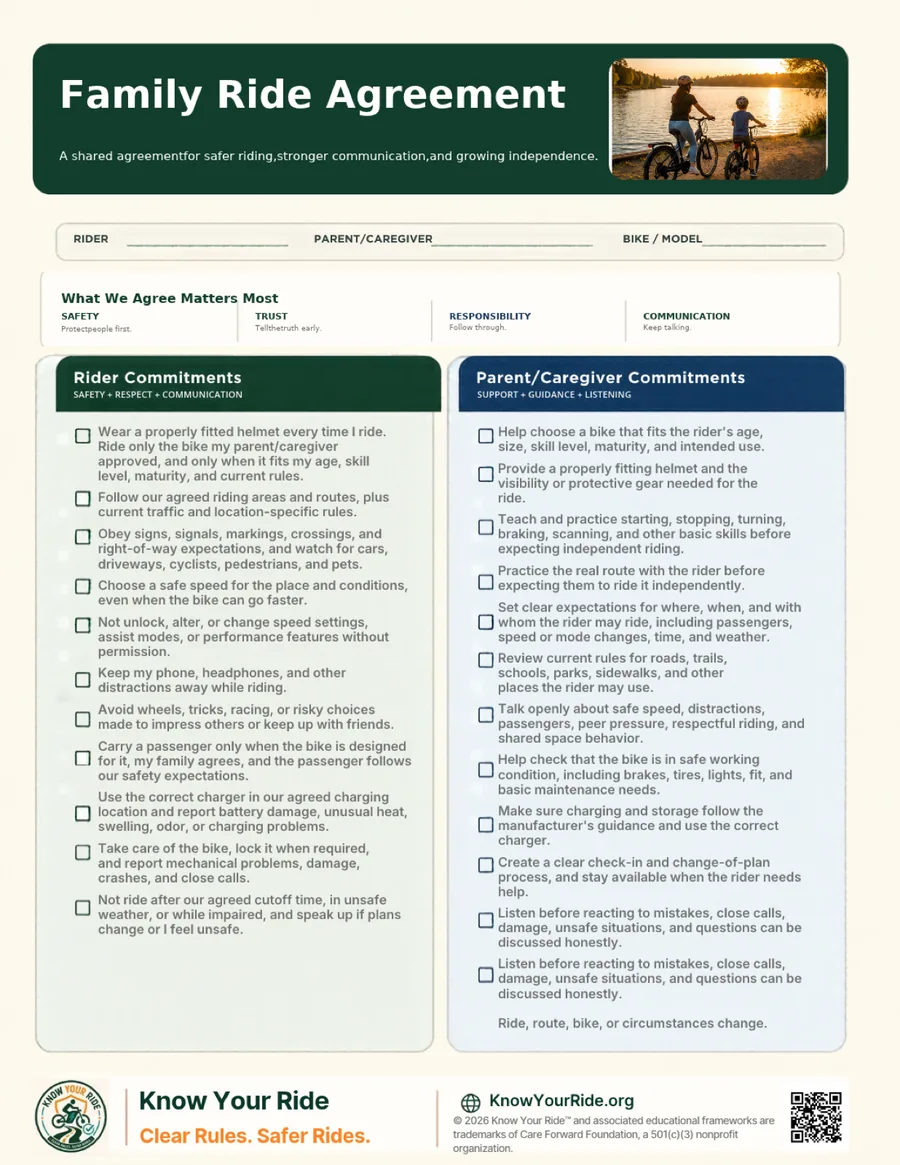
Family riding agreement starter

Use this as starter language and adapt it to your family, daily school pattern, and local guidance.

  • I will wear a properly fitted helmet on every ride, including short trips and quick rides with friends.
  • Near crowded sidewalks, bike racks, crossings, and school entrances, I will slow to walking pace or walk my bike.
  • I will not carry passengers unless the bike is designed for it and my family has approved it.
  • I will not change speed settings, unlock modes, or use unfamiliar throttle/assist settings without checking with an adult first.
  • If something feels unsafe, unclear, too fast, or out of control, I will stop, park the bike, and ask for help.
  • If there is a crash, injury, or immediate danger, I will get help right away and call 911 when needed.
Route + rules

Red flags before school riding

  • The seller cannot show a class label or official specs.
  • The bike can be unlocked beyond its listed class behavior.
  • Throttle or speed details are vague, especially around “off-road only” modes.
  • The bike has foot pegs, motorcycle-style controls, unclear pedals, or unclear intended use.
  • The purchase pressure is mostly social: “everyone else has one,” so the details get skipped.
  • The daily route depends on crowded sidewalks, tight school entrances, unclear parking, or heavy pedestrian areas.